Businessfront
Businessfront operates a network of high-traffic African publications reaching over 2 million readers a month. With no external funding, every design decision had a direct line to revenue. I owned product and growth design across the ecosystem.
Across three years at Businessfront, I:
- Designed and shipped BrandPress from zero — productising a manual, call-driven ad sales process into a self-serve checkout flow that became the company's primary revenue engine
- Led the research, design, and launch of two new publications alongside a unified design system built to support every future expansion
- Ran hypothesis-driven growth experiments across internal campaigns and external client funnels as Product Optimisation Lead
BrandPress
01BrandPress Productisation
BrandPress drove $500K+ in platform revenue and delivered a 20% conversion uplift across key flow stages, turning a manual sales process into the company's primary revenue engine.
Context
BrandPress is Businessfront's core advertising product across its publication verticals, reaching over one million readers a month. But there was no product. Every purchase was made by reaching out to a CSR via email, phone call or WhatsApp. The rep would gather the brief, pass it to editorial, chase approvals, and eventually issue an invoice for every single order.
Challenge
As the company grew, so did the volume and demand for BrandPress. The manual process was creating real business damage:
Deals were being lost to competitors because the sales cycle was too slow
Publishing timelines were inconsistent, frustrating buyers who needed speed
Customer service reps were burning out managing what should have been an automated flow
The company had no way to run paid acquisition into the BrandPress funnel without a self-serve destination to send traffic to
Building this meant trust and clarity had to be built into every step. Simple enough to use without any guidance, for a buyer type ranging from solo PR managers to agency teams handling bulk orders.
My Role
I led the end-to-end design of BrandPress as a self-serve product. This covered the landing page, signup, the full publishing submission flow, checkout, post-purchase and dashboard, including the email sequence triggered at each stage.
What I built
Every step in the flow was a deliberate conversion decision.
01
Qualifying questions on sign-up
Segments users by intent before checkout. Surfaces high-intent buyers early and filters explorers out of the conversion funnel.
02
Inline contextual hints
Guidance at the two highest-friction fields, not a static sidebar. Reduces hesitation at the exact moment it occurs.
03
Save progress bar
Visible safety net at the top of the submission form. Users who know they can resume are more likely to start and complete long forms.
04
Plan switcher in-flow
Upsell at every step. Users can upgrade from Basic to Core or Pro without leaving the flow, reducing post-purchase friction.
05
Two-step checkout
Order review before payment separates commitment from transaction. Outperforms single-page checkout on high-anxiety purchases.
Post launch
Once analytics was in place, I ran continuous experiments across the landing page and submission flow during campaign cycles, A/B testing individual elements and multivariate testing across copy, layout and CTA combinations.
One experiment revealed a revenue-changing insight: heatmap data showed users spending significant time on the Pro and Core plans before purchasing Basic.
The full experiment, hypothesis framework and results are documented in the CRO case study.
Read the full breakdown →Impact
Design System
02Publications & Design System
Building a unified publication system cut design and development duplication by 80% and reduced iteration cycles by 70% across every vertical Businessfront launched.
Context
Techpoint Africa was the flagship. The business wanted to move into adjacent African industries, but every new publication would have meant rebuilding from scratch: new layouts, new components, new development cycles. That model made expansion slow, expensive, and inconsistent.
What I built
Through market and user research, I identified which verticals to enter, first launching with Finance in Africa and Energy in Africa.
The more important deliverable was the system behind them. Headers, story blocks, article layouts, footers, and advertising placements, all built as reusable tokens and patterns. Only the brand layer changes between verticals: logo, colour tokens, typography, editorial voice. Everything structural is fixed and shared. Sports in Africa launched on the same foundation.
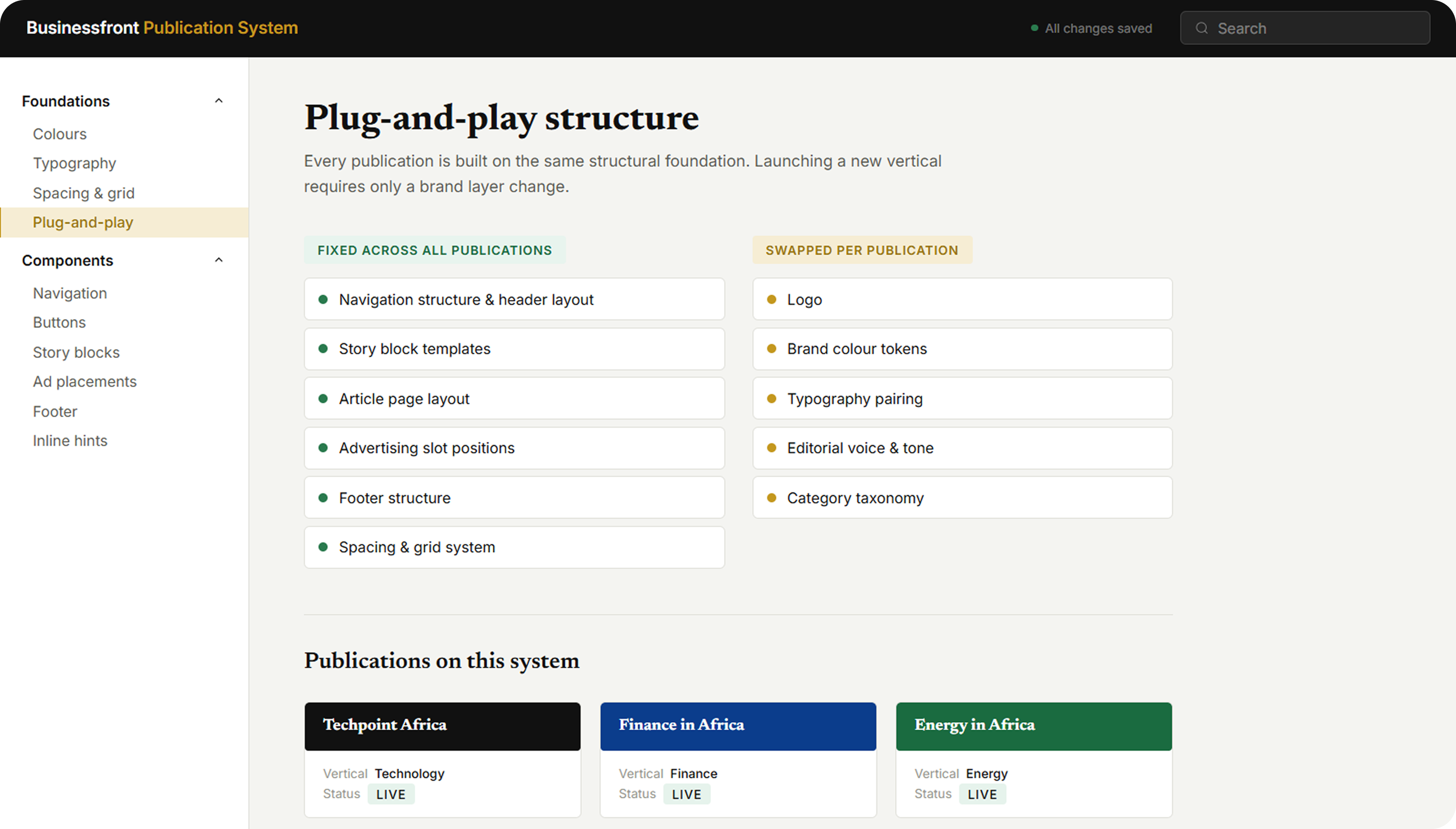
The fixed vs. swapped structure. Every publication runs the same structural foundation with only the brand layer changing per vertical.
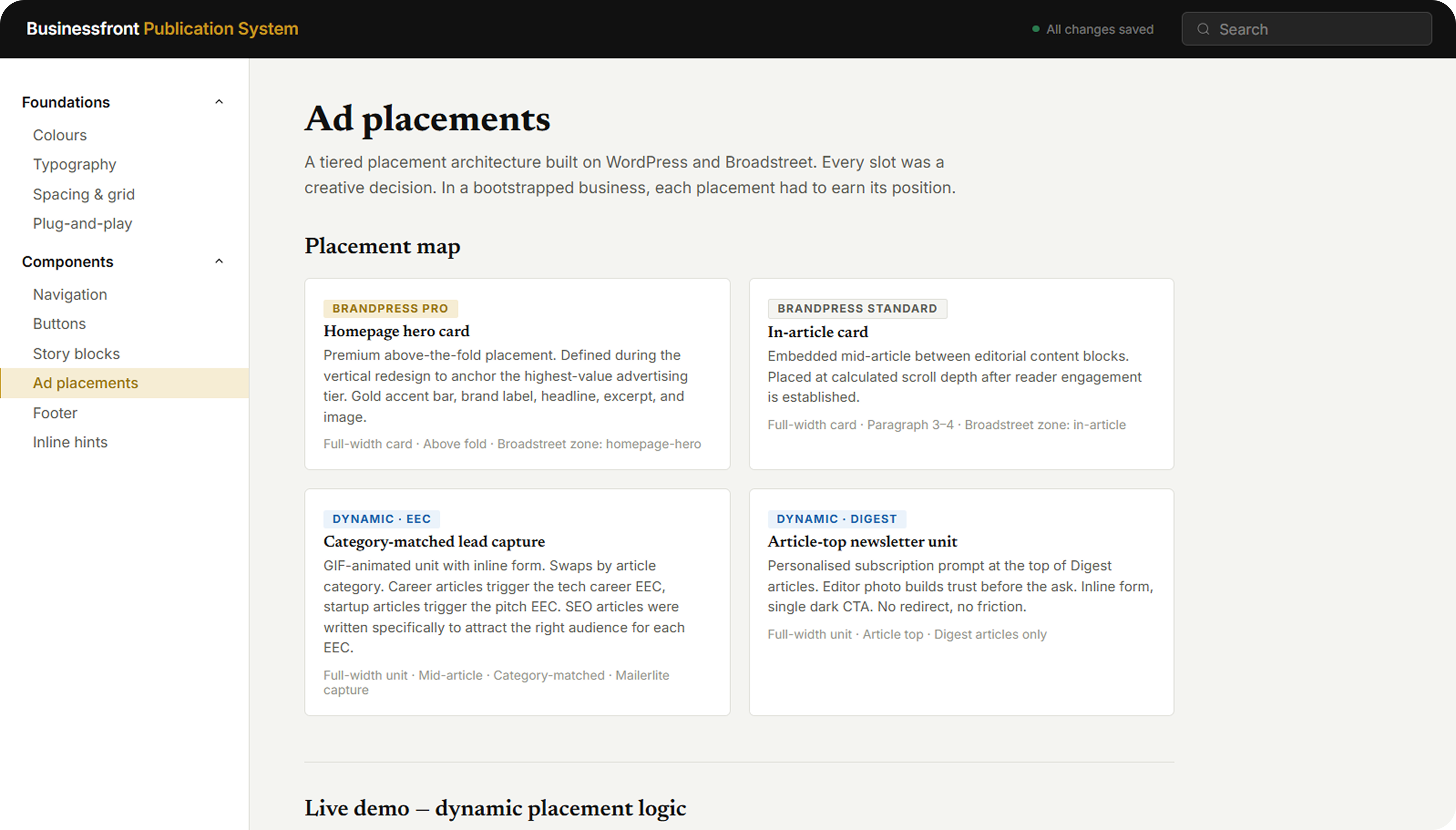
Component library and colour token documentation from the Businessfront publication design system.
Impact
Three years at Businessfront gave me the rare opportunity to design not just for users, but for the business itself, where every decision had a direct line to revenue.
- $500K+ in platform revenue driven through BrandPress
- 80% reduction in design and development duplication across verticals
- 3 publications launched on the same foundation